
Keywords: STM32 vs embedded Linux, MCU vs MPU, embedded platform selection
Choosing the right platform is one of the most critical early decisions in an embedded product. It impacts performance, cost, time‑to‑market, power consumption, and even your product roadmap for the next 5–10 years.
This article compares STM32 (MCU) and Embedded Linux (MPU/SoM) platforms from a practical, engineering and business perspective, and helps you decide which direction makes more sense for your product.
At the end, you’ll also find typical scenarios and a simple decision checklist, plus an invitation to discuss your specific requirements with us for a tailored recommendation.
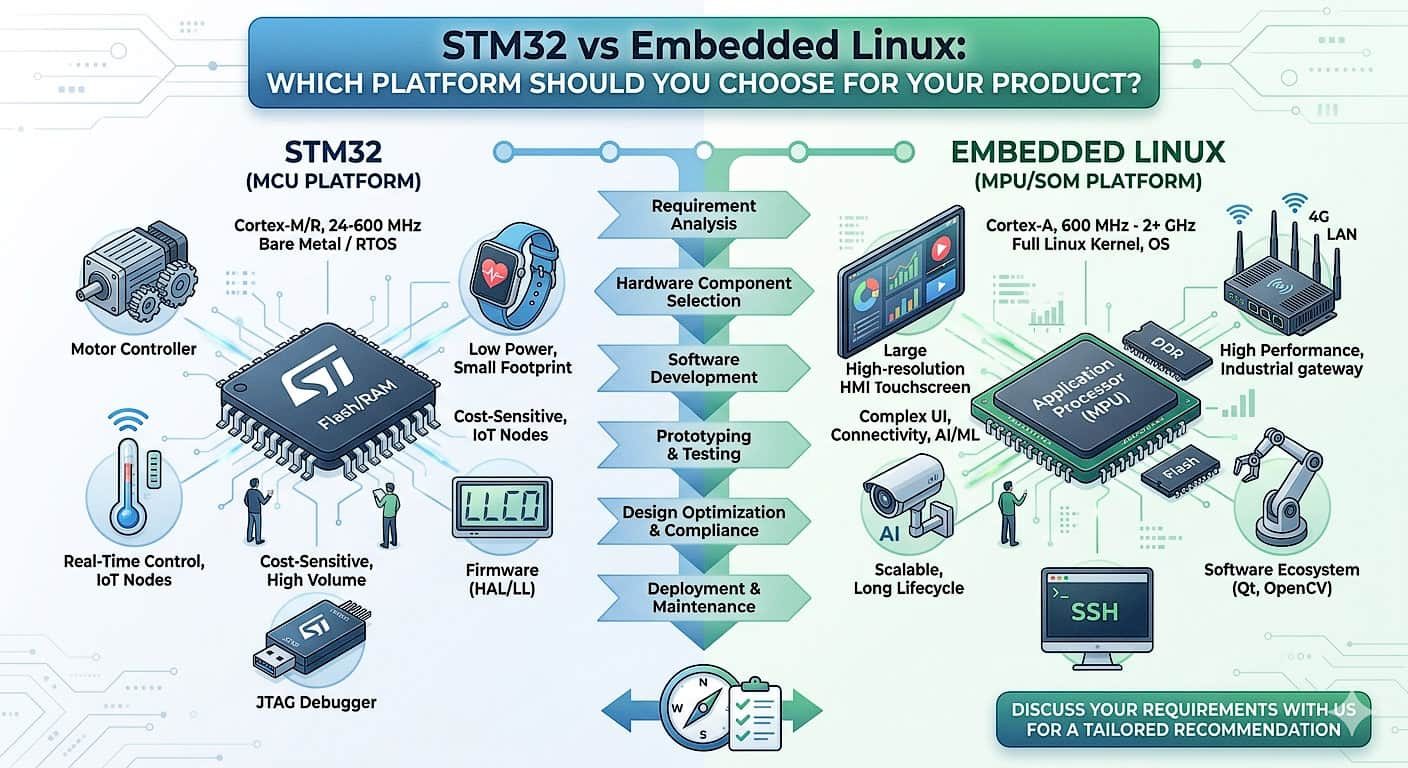
1. What Are We Comparing?
1.1 STM32 (MCU Platform)
STM32 is STMicroelectronics’ family of 32‑bit Arm Cortex‑M/R microcontrollers, widely used in:
- Industrial control
- Consumer devices
- Automotive subsystems
- IoT nodes and wearables
- Medical and instrumentation
Typical characteristics:
- Runs bare‑metal or with RTOS (FreeRTOS, RTX, Zephyr, etc.)
- Flash and RAM integrated on chip
- No MMU (Memory Management Unit) on most STM32s
- Low power consumption
- Deterministic real‑time behavior
- Typically runs one main application with supporting tasks
1.2 Embedded Linux (MPU / SoM Platform)
Embedded Linux refers to running a Linux kernel and user‑space on:
- Application processors (MPUs) like:
- STM32MP1, NXP i.MX, TI Sitara, Rockchip, Allwinner, etc.
- Or System‑on‑Modules (SoM) that integrate MPU + RAM + Flash + PMIC
Typical characteristics:
- Runs full Linux OS (often Yocto, Buildroot, Debian, Ubuntu Core)
- Has MMU, runs multiple processes and complex stacks
- Supports rich frameworks: Qt, GTK, Wayland/X11, GStreamer, OpenCV, etc.
- Designed for complex HMI, networking, multimedia, and connectivity
2. Core Differences: STM32 vs Embedded Linux
2.1 Performance & Complexity of Application
STM32 (MCU):
- CPU: Cortex‑M0/M3/M4/M7/M33, typically 24–600 MHz
- Suitable for:
- Real‑time control loops (motor control, power control)
- Sensor data acquisition & processing
- Simple user interfaces (segment LCD, small TFT with basic graphics)
- Protocol handling (Modbus, CAN, RS485, simple TCP/UDP)
Embedded Linux (MPU):
- CPU: Cortex‑A7/A8/A9/A53/A55, 600 MHz–2+ GHz, often multi‑core
- Suitable for:
- Complex GUI / HMI (touchscreen, animations, video)
- High‑bandwidth networking (Ethernet, Wi‑Fi, 4G/5G, VPN)
- Multimedia (audio, video decode/encode)
- Running high‑level languages (Python, Java, Node.js)
- Edge AI frameworks (TensorFlow Lite, ONNX Runtime)
Rule of thumb:
If your application needs rich UI, file system, multiple high‑level services, or Linux‑only software, you are likely in embedded Linux territory.
2.2 Real‑Time Behavior & Determinism
STM32:
- With bare‑metal or RTOS, you can achieve:
- Interrupt latency in microseconds
- Deterministic scheduling
- Cycle‑accurate timing for control loops
- Used widely in:
- Motor drives, inverters
- Precision instrumentation
- Safety‑critical loops (with appropriate certification process)
Embedded Linux:
- Standard Linux kernel is not hard real‑time
- With PREEMPT_RT or co‑processor/MCU assistance, you can get “soft real‑time”
- Still subject to:
- Kernel scheduling delays
- Interrupt handling overhead
- Jitter due to system load
Typical compromise:
Many products use a hybrid architecture:
- An MCU (e.g., STM32) for real‑time control
- An MPU with Embedded Linux for UI, networking and application logic
ST’s STM32MP1 is an example: Cortex‑A (Linux) + Cortex‑M (real‑time) on one chip.
2.3 Power Consumption & Form Factor
STM32:
- Designed for low power and low leakage
- Deep sleep/standby modes with µA‑level current
- Typically runs directly from battery or small power supply
- PCB:
- Smaller and simpler
- Fewer external components (no external DDR in most cases)
Best for:
- Battery‑powered sensor nodes
- Wearables
- Portable instruments
- Harsh environments with tight thermal constraints
Embedded Linux:
- Requires DDR (SDRAM/DDR3/DDR4/LPDDR)
- Higher idle and peak power
- More complex power tree (PMIC, multiple rails)
- PCB stack‑up tends to be 4‑layer or more
Best for:
- Mains‑powered equipment
- Gateways, routers, industrial panels, terminals
- Devices where power is available and UI/connectivity demands justify it
2.4 Software Ecosystem & Development Speed
STM32 Ecosystem:
- Tools:
- STM32CubeMX / STM32CubeIDE
- Keil MDK, IAR, GCC/Clang toolchains
- Libraries:
- HAL/LL drivers, middleware (USB, TCP/IP, file systems)
- Many ready‑made example projects
- Typical languages: C / C++
- Debugging: SWD/JTAG, in‑circuit debugging, trace
Advantages:
- Very stable toolchains
- Easy to understand memory and timing behavior
- Good for teams with embedded C experience
Challenges:
- Building complex features (e.g. HTTPS, over‑the‑air updates, advanced GUI) needs more engineering effort than on Linux
- Less out‑of‑the‑box software than on a full OS
Embedded Linux Ecosystem:
- Tools:
- Yocto, Buildroot, Debian/Ubuntu cross‑compile toolchains
- Vast open‑source software:
- Web servers, MQTT brokers, databases, OpenSSL, OpenSSH
- GUI frameworks (Qt, GTK), multimedia (GStreamer), AI, etc.
- Languages:
- C/C++, Python, Go, Java, Node.js, etc.
- Remote access:
- SSH, Docker‑like containers, systemd services
Advantages:
- Huge software ecosystem
- Fast integration of protocols and services (MQTT, REST, TLS, VPN, etc.)
- Easier cloud integration and rapid application iteration
Challenges:
- Higher learning curve (build systems, kernel configs, device trees, rootfs)
- More complex debugging (kernel space vs user space)
- OS maintenance and security patching are mandatory
2.5 Cost Structure
STM32 platform:
- Chip cost: from <$1 (low‑end) to a few dollars (high‑performance M7)
- No external DDR in most designs
- Lower PCB layer count and BOM cost
- Lower manufacturing test complexity
Embedded Linux platform:
- MPU + external DDR + eMMC/NAND
- May require PMIC, more power stages
- BOM cost significantly higher than basic MCUs
- Often justified when:
- UI is critical (touchscreen, high‑resolution display)
- You need powerful connectivity, security, and frequent updates
- You run Linux‑dependent software
Total Cost of Ownership (TCO):
- STM32:
- Lower production cost
- Longer software dev for high‑level functions
- Embedded Linux:
- Higher production cost
- Better leverage of open‑source stacks
- More OS maintenance cost over product lifetime
2.6 Security, Connectivity and Remote Updates
STM32:
- Security features (depending on series):
- Secure boot, TrustZone‑M, cryptographic accelerators, secure key storage
- Connectivity:
- Basic Ethernet, CAN, UART, RS485, simple TLS stacks
- Wi‑Fi/Cellular often via external modules
- OTA:
- Implemented via custom bootloader + cloud infrastructure
- Requires more dedicated engineering
Embedded Linux:
- Security:
- Mature kernel security model, user separation, file permissions
- Full TLS stacks, VPN, firewall (iptables/nftables), secure boot chains
- Connectivity:
- Full TCP/IP stack, Wi‑Fi, Ethernet, cellular, VPN, IPv6, etc.
- OTA:
- Well‑established frameworks (SWUpdate, RAUC, Mender, etc.)
- Supports A/B rootfs, rollback, delta updates
If cloud connectivity, remote management and frequent firmware updates are a central part of your product strategy, embedded Linux is often more efficient.
3. Typical Product Scenarios
3.1 Products Better Suited to STM32
You likely lean towards STM32 if your product is:
- A motor drive or industrial controller needing precise real‑time loops
- A sensor node with low power requirements and modest data rate
- A handheld instrument with simple UI and long battery life
- A safety‑critical subsystem that must be deterministic and simple
- A cost‑sensitive high‑volume product where every cent of BOM matters
Examples:
- Smart meters
- Power tools, battery management systems
- Simple thermostats, boiler controllers
- Small PLC modules and IO modules
- Wearable fitness bands without complex multimedia
3.2 Products Better Suited to Embedded Linux
You likely lean towards Embedded Linux if your product is:
- An industrial HMI / panel PC with a modern touch UI
- A gateway or edge device connecting to cloud platforms
- A multimedia device (IP camera, NVR, smart display)
- A connected terminal (POS, kiosk, ticketing machine)
- A device that needs:
- Multiple applications/services
- Complex networking or security standards
- Python/Java/Node.js or AI frameworks
Examples:
- EV charging stations with large touch screens and payment functions
- Industrial gateways with multiple fieldbus and cloud interfaces
- Smart home hubs with multiple wireless protocols
- Video intercom systems with camera and audio
3.3 Hybrid Architectures
In many modern products, the most robust architecture is not choosing one or the other, but combining both:
- Linux MPU:
- Handles UI, connectivity, cloud, data logging
- STM32 MCU:
- Handles real‑time control, safety functions, and low‑level IO
- Communication via:
- SPI, UART, CAN, or shared memory
This approach is especially strong in:
- Industrial automation
- Robotics
- Energy and power electronics
- Complex medical devices
4. Quick Decision Checklist
Use this as a quick filter:
- Do you need a rich GUI (high‑res touchscreen, animations, video)?
- Yes → Embedded Linux
- No / Simple display only → STM32 is likely enough
- Is hard real‑time control (µs‑level, deterministic) critical?
- Yes → STM32 (or MCU co‑processor)
- No → Embedded Linux is acceptable
- Is your product battery‑powered and expected to run months/years?
- Yes → Strongly consider STM32
- No → Both are possible
- Do you rely heavily on advanced networking / security / cloud / containers?
- Yes → Embedded Linux is usually more efficient
- No → STM32 may suffice
- Is your target cost extremely sensitive (especially at high volume)?
- Yes → STM32 generally better
- No → Evaluate Linux if features justify higher BOM
- Do you need to run Linux‑only libraries or high‑level languages?
- Yes → Embedded Linux
- No → STM32 is still in the game
If your answers are mixed or unclear, a short technical consultation can prevent expensive redesigns later.
5. How We Can Help
Selecting between STM32 and Embedded Linux is rarely a purely technical choice; it involves business goals, roadmap, team skills, certification, and maintenance.
We can support you in:
- Early‑stage architecture selection (MCU vs MPU vs hybrid)
- Feasibility analysis for STM32 or embedded Linux
- BOM and cost comparison for different architectures
- Prototype design and firmware / OS bring‑up
- Long‑term maintenance plan (security updates, OTA, etc.)
If you’re planning a new product or considering a redesign, share a few details:
- Your product type and target market
- Key features (UI, connectivity, real‑time requirements)
- Power and cost constraints
- Expected lifetime and volume
We will provide a practical recommendation and architecture proposal tailored to your scenario.